
The Devil You Know
A somber look at the decapitation strike against Ayatollah Ali Khamenei and what it means for the world moving forward.
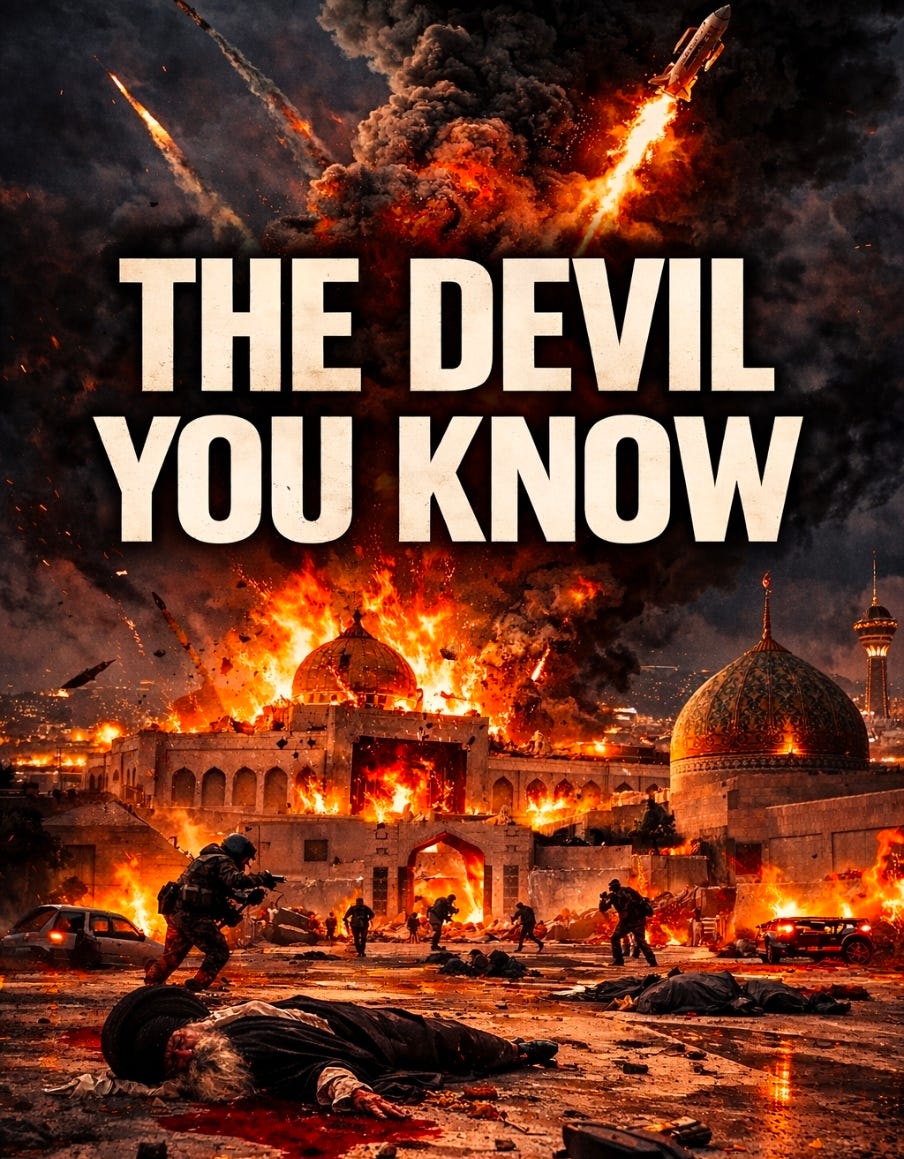
On February 28th, 2026, an Israeli led airstrike on a compound in Tehran killed Ayatollah Ali Khamenei, members of his family, and numerous senior political and military leaders of Iran. Although initially celebrated as a success by Western leaders, including President Donald Trump, the reality of what occurred is far more complicated. Beyond raising serious concerns regarding international law, the decapitation strike put the United States, Israel, and the world into a serious predicament, especially in the long term.
This piece will identify the most significant problem related to the attack and present evidence as to why this situation is a cause for concern for the United States and the broader international community.
Among the myriad of fallacious narratives disseminated by Western governments and the mainstream media, those concerning the intentions of Iran’s nuclear program and the related position of the recently killed Ayatollah Ali Khamenei remain among the most difficult to correct.
Like many leaders both past and present, Ayatollah Khamenei approved organized violence and lived and died as a man who had much blood on his hands. That fact is beyond dispute. But for reasons that remain difficult for Americans to digest, Ayatollah Khamenei was adamantly opposed to the development of a nuclear weapon during his reign.
Beginning in the mid 1990s, Ayatollah Ali Khamenei made it clear to his inner circle that nuclear weapons and weapons of mass destruction would not be tolerated in Iran. In October 2003, Khamenei issued a fatwa stating that the production and use of weapons of mass destruction, including nuclear weapons, were forbidden in Islam. This position was reaffirmed in 2004 and officially cited in 2005 in a statement made to the IAEA. Specifically, the production, stockpiling, and use of nuclear weapons were forbidden under Islam.
In 2010, all statements and positions regarding the fatwa and the Ayatollah’s opposition to nuclear weapons and weapons of mass destruction were compiled and published on the Ayatollah’s official website. From 2010 through the 2020s, this position was reiterated regularly and cited not only by the Ayatollah and Iranian leadership but also by officials in the United States.
It is also important to note that this was not merely a symbolic position. Anyone caught furthering a weaponized nuclear program would have been charged with “corruption on earth” and executed.
Although it is curious and seemingly contradictory that a man who would approve of violence in most regards would take such an adamant position against nuclear weapons and weapons of mass destruction, it is not that difficult to understand. Khamenei believed Iran could not be trusted with such a weapon without eventually using it against another Muslim neighbor. As an Ayatollah, he did not want the devastation of a regional nuclear catastrophe to define his historical legacy. So despite the fact that Khamenei supported ruthless violence in many respects, nuclear weapons were never allowed to be developed.
Ayatollah Ali Khamenei’s stance on nuclear weapons infuriated many Iranian hardliners. Some wanted nuclear weapons for offensive purposes while others saw them as a defensive guarantee. Their logic was straightforward. Once a state possesses nuclear weapons, the world tends to leave them alone. North Korea is the obvious example. Despite the fact that many in Iran wanted that leverage, Khamenei would not budge from this position.
Ultimately, the United States dispute with Iran has always been based on a single premise. Iran must not obtain nuclear weapons.
Under the JCPOA agreement signed by President Obama, America and the international community put a system in place that Iran was complying with. When President Trump withdrew from that agreement in 2018, Iran was no longer bound by its requirements. The Iranians immediately resumed enriching uranium, as is their legal right, but they allowed the IAEA to retain access to their facilities.
Fast forward seven years and negotiations between the United States and Iran began again as America wanted to rein in the Iranian enrichment program and Iran had enough highly enriched uranium to leverage a good deal. The negotiations were led by Steve Witkoff on behalf of the United States and Abbas Araghchi on behalf of Iran. From all sources, these talks went remarkably well. But then in June 2025, after six meetings, the United States and Israel launched a surprise attack on Iran.
For twelve days, that war with Iran unfolded. Afterwards, President Trump told the world that the campaign was “a spectacular military success.” Moreover, Trump also stated that “Iran’s key nuclear enrichment facilities have been completely and totally obliterated.”
On July 3, 2025, I wrote that this narrative about the success of the strikes was misleading.
“Israel and America’s twelve day war with Iran was more than a misstep. Iran’s enrichment capability was not eliminated nor are they deterred. Their highly enriched uranium has not been destroyed. It has gone missing. Nothing good came from this debacle. It was not a win, smart or strategic for the United States or Israel. It did not make anyone safer.”
As I stated last July, the highly enriched uranium was clearly not destroyed and the facilities were not all eliminated. In fact, the only thing America actually accomplished was pushing a previously transparent enrichment program into the dark.
Proving that my understanding of the previous attack was correct and that the official narrative was wrong, the United States and Iran had to reopen negotiations in February 2026 to deal with the still unresolved nuclear matter.
At the second meeting held in Geneva on February 26th, Iran presented what was, objectively, a workable proposal. They affirmed in writing that they would not pursue nuclear weapons. They offered to shut down their facilities for five years, allow another country to take possession of their uranium and reduce it below weapons grade, and permit the IAEA and inspectors chosen by Trump to inspect any facility at any time.
In exchange, after five years they would be allowed to participate in a multinational consortium to develop civilian nuclear energy under adequate inspection rules.
The United States response to that proposal was to assist Israel in killing Ayatollah Ali Khamenei two days later on February 28th, 2026.
If the objective truly is to prevent Iran from acquiring nuclear weapons, then this was a profoundly irresponsible and misguided way to go about it. Despite being a brutal man who signed off on state sanctioned violence, Ayatollah Ali Khamenei was at the same time the single figure who had consistently prevented Iran from building nuclear weapons. Now his son, Mojtaba Khamenei, a hardliner who has just watched Israel kill his father, mother, wife, sister, and son, has become the new Ayatollah and the supreme leader of the country.
There is an old proverb that goes “Better the devil you know than the devil you do not.” It essentially means that something imperfect but predictable is ultimately safer than the issues that may arise from something or someone new whose behavior is a complete unknown. While Ayatollah Ali Khamenei was terrible, his position on nuclear weapons was predictable and consistent over decades. Although the world may temporarily seem safer with his sudden departure, the truth is that the new Ayatollah is far more likely to pursue nuclear weapons.
I genuinely hope I am wrong and that Iran will remain a non-nuclear state. But given who was killed, how it occurred, and who is now in control because of it, I fear we are witnessing a textbook case of a situation where the world would have been better off dealing with the devil we knew.
As always, I thank you for your continued support and readership.
Sincerely,
Jon Kurpis
💪If you enjoyed this article and are not already a free subscriber, please subscribe to the Jon Kurpis Substack today.
DISCLAIMER
The Jon Kurpis Substack is a personal platform and reflects only my individual thoughts, opinions, and perspectives. Nothing published here should be interpreted as official communication or correspondence in my capacity as an elected official. The views expressed do not represent the positions of any municipality, governing body, political party, or any other elected official or government entity.