
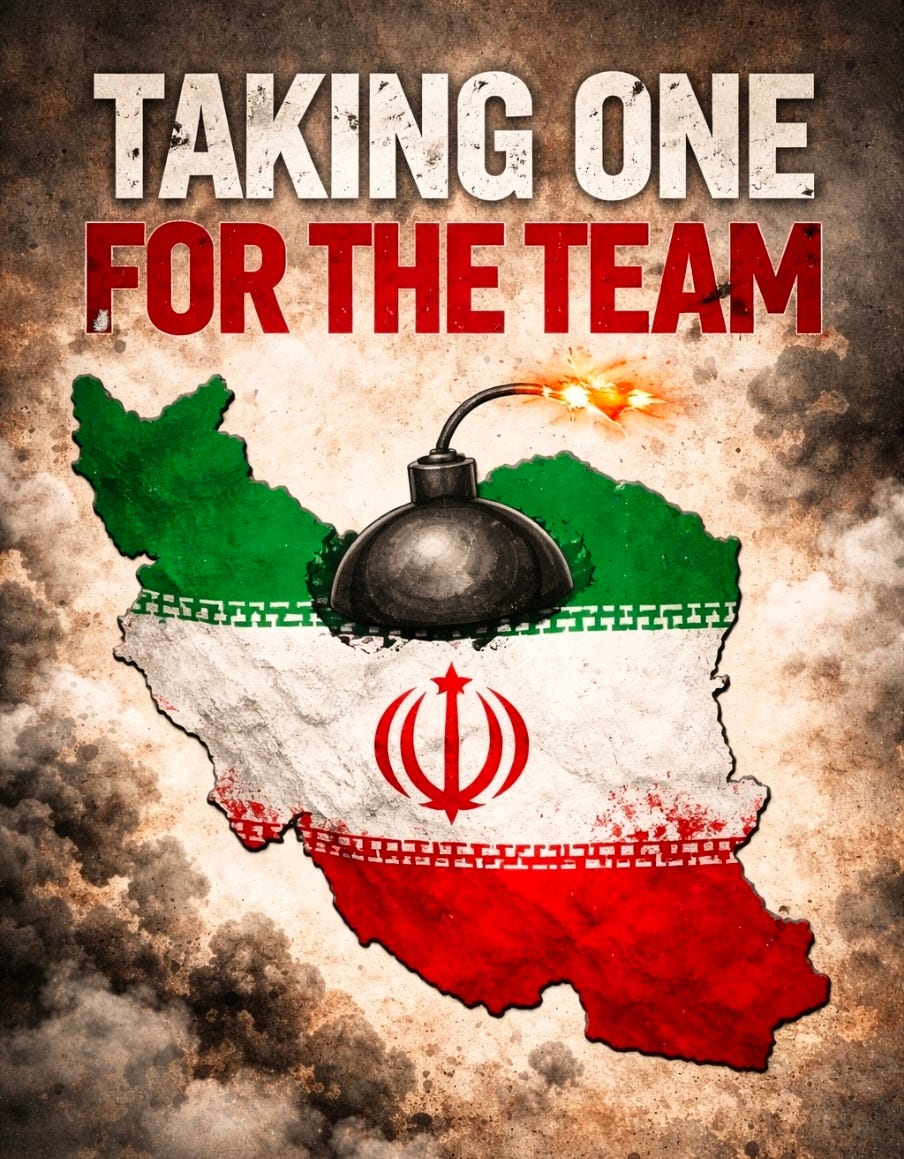
Taking One for the Team
Reconciling the inexplicable security failure that resulted in the death of Ayatollah Khamenei and a collection of top-ranking Iranian leaders.
Before we begin, it must be made clear that this article does not seek to glorify death, or any person or strategy on either side. Moreover, it does not judge the American and Israeli attack on Iran, or seek to question Iran’s nuclear ambitions. As I have written in the past, for every good actor on either side there are equally bad people pushing for war. What this piece sets out to do is assess the circumstances surrounding the successful killing of the Ayatollah along with Iran’s elite political and military leaders, and to make sense of the peculiar conditions that allowed for it to occur by uncovering the true reasoning behind it.
Background
In the early morning hours of March 1st, 2026, Israeli warplanes, with the assistance of the United States, launched a brazen attack on a Tehran compound that served as the home offices of the Ayatollah, the Iranian presidency, and the countries national security apparatus. The strikes, dubbed “Operation Roaring Lion”, hit 3 sites on the compound simultaneously using precision, high intensity missiles. From a strictly US or Israeli military perspective, the attack was a tremendous success, leaving the compound in a heap of rubble. And after the dust settled, it was announced that the Ayatollah himself had been killed in the attack. In addition to Khamenei’s death, the strike also killed the Commander of the Islamic Revolutionary Guard Corps, the Commander of its Aerospace Force, Iran's Defense Minister, the Head of the Military Council, the Ayatollah’s top advisor, and Iran’s Deputy Intelligence Minister.
If you read reports from the mainstream media, the success of this mission is presented as the result of extraordinary intelligence work from the CIA and Mossad. American agents are reported to have been watching the Ayatollah for months, tracking his travel patterns, whom he met with, and how he communicated. In addition to the Supreme Leader himself, US and Israeli intelligence are also reported to have monitored Iran’s top political and military leadership.
In truth, this sort of foreign surveillance was nothing new to the Iranians. And as a result, highly influential military and/or political figures rarely met together and were even less likely to meet directly with the Ayatollah for fear of precisely such an attack. Yet despite the massive buildup of US forces in the region, the evacuation of embassies, and the public expectation that a decapitation strike against Iran’s leadership was imminent, the narrative is that Iranian officials made the highly unusual decision to gather together at the worst possible moment, and that US and Israeli forces simply took advantage of the opportunity.
The media attempts to justify this by claiming that these intelligent leaders, who fully understood the risks of their actions and who did not behave in such a cavalier manner even in calmer times, now suddenly felt safe congregating together because their meeting occurred at dawn. And since American forces prefer operating under the cover of darkness, this somehow rendered their get together safe. However, this explanation fails to account for the fact that Israeli forces have demonstrated a willingness to strike during daylight hours, and that a meeting at 6am would not, in itself, have guaranteed safety.
So why would these senior officials and the Ayatollah act in such a reckless manner and take such a chance? They had the ability to communicate through secure channels and to do so from the safety of impenetrable bunkers. How could they be so careless at the worst possible moment when they had not behaved this way during more stable periods?
The most likely conclusion is that this was not a mistake. In fact, it was intentional. The Ayatollah and these senior leaders understood the risks and accepted them for a reason that the West does not fully understand or take seriously, and that reason is Shia martyrdom.
Martyrdom in Shia Culture
In order to understand the concept of Shia martyrdom, it is important to look at it beyond the typical Western interpretation. For many people in America, martyrdom is understood in narrow terms. It is imagined as a poor young man, manipulated into wearing a suicide vest and detonating himself on a bus or in a café, motivated by promises of 72 virgins and recognition after death. For many in the West, that is the literal extent of what martyrdom means. However, to truly grasp the concept of martyrdom, we must understand its historical and religious foundation and how it relates to Islam.
Islam has two main branches (Sunni and Shia). Sunni Islam makes up the majority of Muslims worldwide. Shia Islam, while a minority globally, is the majority in Iran. Most Iranians practice Twelver Shia Islam, and the Ayatollah serves as the highest-ranking religious authority, holding both spiritual leadership and political power.
For those who practice Shia Islam, martyrdom is a very important part of the faith. It is by definition understood as being killed in the path of God for a righteous cause. Within this tradition, martyrdom is not seen as death, but as the ultimate act of devotion and sacrifice. It is regarded as something sacred and more meaningful than life itself.
The reason why martyrdom is so essential to Shia Islam is because it is derived from a key event in the history of the religion. In 680 AD, Imam Hussein, the grandson of the Prophet Muhammad, was killed at the Battle of Karbala. Shia Muslims believe that Imam Hussein’s death was an act of exceptional bravery because he stood up for justice and made the ultimate sacrifice for truth. His killing is the defining moment of the faith and the spiritual core of the Shia identity.
In modern times, the death of Imam Hussein is still commemorated every year, and his martyrdom remains central to Shia belief and to Iranian society. Because of this, there is no higher honor within that tradition than to be killed defending the country, defending Iran’s political and religious system, or being assassinated because of one’s political or religious leadership. Such a death is seen as the quintessential sacrifice in the path of faith and duty.
From a Western perspective, we tend to only understand martyrdom from the spiritual angle. We are able to grasp and accept that many Shia Muslims believe that being a martyr brings specific religious rewards, such as immediate entrance into paradise and special status with God. However, we have very little understanding of the equally important political and societal effects that martyrdom has in Iran.
In Shia political culture, martyrdom brings instant political legitimacy and becomes a powerful force in bringing people together. It forges solidarity and creates the conditions for escalation and calls for revenge. As much as martyrdom is a religious sacrifice, it simultaneously carries political meaning of equal importance. Becoming a martyr can therefore be used to inspire loyalty, resistance, and unity.
The Lead Up To Martyrdom
In addition to the security lapse that allowed so many top officials to be gathered with the Ayatollah at the time of the attack, there were also reports, 8 days before the strike, indicating that the Ayatollah and senior leadership were preparing themselves for martyrdom. Specifically, Liga.net referenced a New York Times report stating that “Iran's Ayatollah prepares for possible death - has already given a number of indications of this eventuality. Ali Khamenei has allegedly already named several of his successors and instructed all leaders to do the same.”
The article goes on to say that the Ayatollah “issued a series of directives, defining four levels of succession for each of the military command and government positions that he personally appoints…”
While having a plan of succession and the ability to move forward in the event of a national tragedy is obviously sound domestic policy, the timing and nature of the reporting so close to the deadly attack suggests that the message may have been intended to communicate more than routine government contingency planning.
Strategic Autonomy
More than almost any other nation, Iran places immense value on its independence and strategic autonomy. And much like India, Iran has historically viewed it as unacceptable for its national fate to be determined by the interests of outside powers. This principle has shaped its decisions even when doing so came at a significant cost. For example, Iran has been presented with extensive opportunities for military and economic assistance from countries such as Russia and China. Even when such help was desperately needed to address immediate security and/or economic concerns, Iran has mostly rejected these offers, wary of creating dependencies or future obligations that could compromise its independence.
This same principle applies to Iran’s broader strategic posture. In recent negotiations with the United States that took place during February 2026, this perspective was reflected in the posture and proposals of its diplomatic representatives. Iran’s negotiating team, led by the highly experienced Abbas Araghchi, arrived in Geneva with a proposal that was both serious and workable. It reflected Iran’s effort to engage on terms consistent with its sense of autonomy.
The Iranian proposal included reiterating that Iran does not seek nuclear weapons, will allow all nuclear material to be inspected by the IAEA and/or outside groups that were acceptable to America. They also offered to halt all nuclear production for a period of 3 to 5 years and allow for all current material to be reduced to a level that was in line with civilian use measurements. And after the 5-year halt, Iran would join an international consortium whereby they could continue to develop civilian nuclear technology that was completely transparent and within their right under international law. For doing all this, America would be required to lift sanctions on Iran.
The American counterproposal, or what can be more accurately classified as an ultimatum, was neither reasonable or workable. The United States demanded concessions that included the surrender of all nuclear materials, the dismantling of existing nuclear technology, the permanent ban on both military and civilian nuclear development, limitations on missile programs, and constraints on aspects of Iran’s foreign relationships. In exchange, sanctions relief was described as conditional and not guaranteed, dependent on future American decisions rather than binding commitments
Iranian officials, along with geopolitical analysts worldwide, correctly interpreted the US ultimatum as coercive rather than reciprocal, reinforcing the long-held belief that external Western and Israeli powers were seeking an excuse for regime change. This ultimatum, along with rising tensions and explicit military threats, contributed to a determination in which conflict appeared not as a distant possibility, but as a near-term unavoidable certainty.
Given this reality, the idea that the Ayatollah and so many of Iran’s most important political and military leaders would suddenly choose to gather together in a known and identifiable compound, despite a long history of avoiding exactly that kind of vulnerability, becomes all the more difficult to explain through conventional reasoning alone.
The Likely Truth
Although nobody outside of that inner circle could ever know their intentions with certainty, all of this strongly indicates that the Ayatollah and the senior Iranian leadership were intentionally placing themselves in a position where martyrdom was a possibility. They knew they were being watched and their movements were monitored. They were fully aware of the military buildup around them and the very real threat of a decapitation strike. Most importantly, they also understood what their deaths would mean.
The Ayatollah and the other leaders who were killed recognized that their martyrdom would create an immediate sense of unity, grievance, and purpose throughout Iran. Moreover, it would solidify their legacy as men who stood their ground in defiance and accepted death in the path of what they believed was their duty to the country and the people.
The Ayatollah and the other Iranian leaders who died in the attack could have been escorted to impenetrable bunkers where their safety would have been guaranteed. But it appears as though personal survival was not their primary objective.
For the Ayatollah and the other military and political leaders, the overriding goal was and has always been the preservation of Iran’s strategic autonomy and its independence from outside control. Achieving that goal now required more than military capability. It required national solidarity and a population willing to endure sacrifice and resist external pressure over the long-term.
Having exhausted diplomatic options, and after ensuring multiple layers of succession across the political and military hierarchy, the Ayatollah and elite military and political leadership accepted martyrdom as the necessary outcome. They gathered in a place that was known, visible, and vulnerable. Not because they were careless, and not because they were unaware, but because they knew they would likely be killed and recognized the symbolism and what would follow.
They were not simply leaders who carelessly risked being killed. They were figures whose deaths, in that moment and under those circumstances, could reshape the political and emotional landscape of their nation and inspire the country to fight for the strategic autonomy the United States and Israel were attempting to take away.
Ultimately, these men likely believed they were making a sacrifice in service of a cause they viewed as larger than themselves. As we say in America, the Ayatollah and the senior Iranian leadership were “Taking One for the Team.”
As always, I thank you for your continued support and readership.
Sincerely,
Jon Kurpis
DISCLAIMER
The Jon Kurpis Substack is a personal platform and reflects only my individual thoughts, opinions, and perspectives. Nothing published here should be interpreted as official communication or correspondence in my capacity as an elected official. The views expressed do not represent the positions of any municipality, governing body, political party, or any other elected official or government entity.