
Own Worst Enemy
A Review of the Trump Administration's Unconventional Negotiation Regimen and How the US is Squandering the Opportunity to Make Peace both in Ukraine and with Iran.
When it comes to negotiations, even relatively straightforward circumstances can become intense. One only has to look at the vitriol that occurs with divorce proceedings to understand why these processes require competent assistance. As the stakes grow, so do the variables and the need for proper guidance. This can be observed in complex plea deal structuring or the signing of a professional athlete by a sports franchise. At the upper end of the spectrum is big business mergers and acquisitions. In these cases, an array of financial, legal, and other experts are required, along with adequate time to perform due diligence. As complex as these multi-billion-dollar deals may be, it must be understood that even the most sophisticated negotiation in the private sector are elementary when compared to what goes into deliberations between two sovereign nations.
Diplomatic consultations, trade relations, nation-to-nation security frameworks, nuclear disarmament treaties, are just a sampling of the myriad of intricate matters in play. When war is added into the equation, these global deliberations enter a realm of difficulty that even the greatest captains of industry would lack the complete skill set needed to maneuver effectively.
A good case in point is Elon Musk. Musk is the foremost business mind of the era, if not one of the greatest of all time. He is revolutionizing space exploration, satellite internet communications, and the auto industry all while acquiring Twitter in the process. Not only is Musk able to do all of this simultaneously, he has done so in a way that has amassed a personal net worth of $850 billion dollars.
To put that staggering sum in perspective, if Jeff Bezos, Bill Gates, Mark Zuckerberg, and Warren Buffett combined all of their money, they would still be $131 billion short of where Musk currently stands. On top of all of this, Musk’s companies’ interface with governments across the globe, so he is not exactly a neophyte in this arena. Yet even with the President of the United States, the House of Representatives, and the Senate all in his corner, along with a mandate from American voters, Elon Musk was unable to make meaningful progress with DOGE.
This is because unlike business where the financial outcome is paramount, negotiating with a government and its entrenched framework is far more complicated due to the multilayered primary objectives that all must be met. And when the nations that must work together also happen to be killing each other on the battlefield, the level of difficulty compounds dramatically.
To maintain the upper hand diplomatically, countries employ a massive infrastructure fully dedicated to these pursuits. While we could discuss the intricacies of the US State Department with it’s 63 billion dollar annual budget, 270 embassies and 75,000 employees, it will be more helpful to delve into what a nation typically deploys for important negotiations with a foreign nation. Below are some general benchmarks to help guide this evaluation.
Generally speaking, formal negotiations between nations may include 5 to 10 senior negotiators per side, along with full-time advisors and experts. These experts include diplomats, generals, military officers, lawyers, intelligence analysts, and translators. The number of people in a main room during a negotiation can exceed 50, with upwards of 300 people in total per side on site.
In terms of meetings, formal sessions can exceed 25 in number, and smaller working groups will meet several hundred times over the course of these negotiations. The process is highly organized, with multiple parallel groups negotiating simultaneously. Groups may work on issues including, but not limited to, disarmament, borders, elections, economic recovery, war crimes, military withdrawal dates, and more.
The men and women tasked with participating in these deliberations are highly specialized professionals. Senior military officers, most likely a general, will negotiate matters such ceasefires, demobilization, and related issues. Profoundly experienced lawyers focused on treaties, international and constitutional law will scour everything and write and re-write hundreds of drafts. There will be intelligence officers present to assess the credibility of the other side and any related security risks. Executive leaders such as the president or prime minister typically only join the process at the final phase or when a very high-level decision needs to be made.
More often than not, and especially when negotiating the end of a war, mediators will also be essential in getting the sides to a formal agreement. The mediation process usually begins when negotiations between countries are deadlocked. The parties will be separated into different rooms, and then accomplished mediators will listen, take notes, and propose solutions. These professionals will then physically shuttle back and forth between sides dozens of times per session to further discuss the details, and help formulate a compromise. The diplomatic mediation protocol is long and complicated, as even an obscure detail can literally be what continues a war.
While people often point to the fact that it only took the US a few days to complete an agreement with Japan to end World War II, that perspective fails to recognize that it was a surrender, not formal negotiations. For typical peace negotiations that end an active conflict, it can take 1 to 5 years of ongoing discussions to reach the formal agreement and signing ceremony. That said, there are examples of very expedited, successful negotiations in scenarios where the proper groundwork has been completed.
An excellent example of what is possible in terms of a productive negotiation atmosphere is the Dayton Peace Accords that took place in 1995 to end the war in Bosnia.
The War in Bosnia
After the fall of communism, the country then known as Yugoslavia, which was located in the area still known as the Balkans, separated into what would end up being 7 countries. In 1991, Slovenia, Croatia, and North Macedonia declared independence. Then in 1992, Bosnia tried to break away from what remained of Yugoslavia, leaving Serbia, Kosovo, and Montenegro still united.
Unlike the other republics that made up Yugoslavia, which were overwhelmingly comprised of a single ethnic majority, Bosnia was multi-ethnic in it’s makeup. 44% of the Bosnian people were Muslim, known as the Bosniaks. 31% were Orthodox Christians known as Bosnian Serbs and 17% were Croatian who were Catholic.
Between February and March 1992, Bosnia held a referendum to decide if it should declare independence. The Bosnian Serbs were against the idea and fully boycotted the election. As a result, 99% of the vote came back in favor of separation from what was left of the former Yugoslavia. The Bosnian Serbs, who had boycotted the referendum, refused to accept the results and demanded a Serb state be created inside Bosnia that would remain connected to the former Yugoslavia. When this demand wasn’t accommodated, the Bosnian Serbs went to war for control of Bosnia from 1992 to 1995. During the first 3 years, the Bosnian Serbs were successful capturing approximately 70% of Bosnia. However, a tragic event changed the entire direction of the conflict.
In July 1995, Bosnian Serbs captured a United Nations declared safe zone in Srebrenica. As part of this military campaign, 8,000 Muslim men and boys were executed to ethnically cleanse the area. This horrific massacre would later be classified as genocide.
Since the United Nations had failed to stop what was the worst mass killing in Europe since WWII, the United States faced immense pressure to intervene. From August through September 1995, President Clinton pushed NATO to attack along with United States led airstrikes. Bosnian Serb military power was significantly weakened, and Bosnian and Croat forces began to reclaim lost territory.
Serbia (part of former Yugoslavia) President Slobodan Milosevic realized that the Bosnian Serbs could not defeat NATO forces and that continuing on the same path would lead NATO to strike Serbia itself. As a result of this new reality, President Clinton was able to compel the Dayton Peace Accords in November 1995.
The Dayton Peace Accords
To demonstrate that the United States was committed to negotiations and a peaceful conclusion to this violent conflict in Bosnia, President Clinton, who was not fond of international relations and not particularly good at it, assigned diplomat Richard Holbrooke to live at Wright-Patterson Air Force Base in Dayton, Ohio along with a large group of experts and top level negotiators. Holbrooke was also tasked with forcing the presidents of Serbia (former Yugoslavia), Bosnia, and Croatia to travel to Dayton, Ohio, along with all of their negotiators, support staff, and experts and live there as well until a peace agreement could be reached.
To put the size of the combined negotiation teams in perspective, well over 1000 people were involved. This included more than 50 core negotiators, 300+ diplomats and lawyers, 300+ military and technical staff members, and over 400 people responsible for support and logistics.
For all intents and purposes, Holbrooke sequestered all sides on the base and iinsisted on constant, grueling negotiations, with days lasting between 16 and 20 hours. Although Republicans had an intense disliking for the President and were also opposed to military intervention in Bosnia, Clinton was able to drum up Republican support for the negotiations mostly through Bob Dole and John McCain who he won over in regards to the peace initiative.
Over a 3 week period, the sides held approximately 300 meetings, created dozens of draft agreements, and collectively put in more than 250,000 man hours. These highly serious negotiations to end the war culminated with a formal signing ceremony on December 14th, 1995, in Paris, France.
As remarkable as these negotiations appear today, they were viewed at the time as simply part of the job and as what was necessary to achieve a suitable diplomatic outcome. In fact, most of you probably did not even realize that they happened. What the Dayton Peace Accords ultimately illustrate is the lengths responsible governments go to when they are committed to obtaining peace.
With that in mind, let us now take a look at the effort the Trump administration put forth during the recent peace negotiations that took place in Geneva, Switzerland.
February 2026 Peace Talks
In February 2026, the world was informed that major negotiations to end the war between Russia and Ukraine were taking place with the Americans, Russians, and Ukrainians in Geneva, Switzerland on the 17th and 18th of the month.
The Russian delegation, was headed by Vladimir Medinsky and comprised of over 15 delegates including Deputy Foreign Minister Mikhail Galuzin. The Ukrainians were led by Rustem Umerov and Kyrylo Budanov (Head of the Office of the President of Ukraine) along with a sizable Ukrainian support team.
The Americans, who were supposed to set the tone of these talks, came into the negotiations with just 4 people. Special Envoy Steve Witkoff, who has done an excellent job considering his lack of formal diplomatic experience, was lead negotiator alongside Trump's son in law, Jared Kushner. While naturally intelligent, Kushner is without significant experience and does not even hold an official position in the government. Thereby, Kushner’s only standing is that of his relationship with the president. Along with Witkoff and Kushner came Secretary of the Army Dan Driscoll and an additional general needed for technical reasons.
These negotiations, which were billed as something that could end the war in Ukraine, lasted a grand total of 6 hours on the first day and 2 hours on the second day. They occurred in bilateral and trilateral formats and while the talks were described afterwards as “difficult, but businesslike”, nothing tangible came from them.
What startled many observers was the lack of seriousness displayed by the Trump administration compared to any other time America has gone about seeking peace in earnest. Consider what Henry Kissinger brought to the table to end the war in Vietnam, or what the Clinton administration put forth to end the war in Bosnia.
The US team not only failed to achieve peace, but they didn’t even make any concrete steps to get closer to it. Meanwhile, their half-ass effort undermined the credibility of the United States abroad as they appear to be highly unserious and disrespectful of other nations involved in the process.
Of all the things that occurred in Geneva, the 2 pitiful meetings with the Russians and Ukrainians wasn’t the worst of it.
The fact of the matter was that Russia and Ukraine wasn’t supposed to be on the agenda. The Geneva negotiations were scheduled to be a genuine attempt by the Americans to seek peace with Iran. But instead of dedicating whatever amount of time and effort necessary to prevent an impending war with Iran, US dialogue with the Iranians lasted only 2 hours before the being abruptly shut down to instead talk with the Russians and Ukrainians. Unbelievably, the same inadequate team sent to handle the Russia-Ukraine negotiations was also utilized to negotiate with Iran (minus the military contingent.) This is truly remarkable diplomatic behavior in a negative sense as it’s hard to recall American diplomats acting so insincere with another nation who we were trying to prevent a war with.
Objectively speaking, peace negotiations between nations are often brutal. Arguments occur and harsh rhetoric and threats are common. That said, countries don’t schedule consequential peace negotiations in Switzerland and then handle it so unprofessionally. By taking such a flippant approach, the world views America not as a shining city on a hill, but as a bunch of entitled clowns who are unserious about peace, dead set on war, and untrustworthy when it matters most.
As an aficionado of history and someone who routinely analyzes geopolitical happenings around the world, I approach all situations, countries, and leaders with an open mind. More so than most Americans, I remain objective about President Trump, not letting myself fall into the knee-jerk love-or-hate perspective many formerly impartial analysts now find themselves having. From an intellectual and political intrigue perspective, I appreciate the uniqueness of President Trump. It is unbelievably rare for an outsider to take over politics on the global stage, and it is especially unique that a man with Trump’s shortcomings was able to pull it off. I also recognize that being such an outsider makes problems more likely to occur, but with those incidents also comes a different perspective and strategy that would never otherwise unfold or be applied. That said, there is no possible way to justify or approve of the way President Trump or his State Department is handling negotiations with foreign counterparts, especially in regards to the war in Ukraine and potential conflict with Iran.
At the heart of the matter and the biggest overall issue with this diplomatic posturing is that America is currently on the verge of attacking Iran, and the negotiations in Geneva were supposed to help end this conflict before it erupts. To be frank, I am not even sure why the United States is on the verge of war with Iran.
Congress hasn't authorized it.
The administration hasn't really explained it.
Iran hasn't attacked anyone.
The American people, including Trump's base, aren't in favor of it.
It will cost the Republican Party control of the House in the midterm elections.
All sides involved are open to negotiation.
It will hurt the global economy.
And President Trump told us that the strikes on Iran in 2025 had completely devastated their nuclear program.
So, I fail to find a reason why we're on the verge of war. If anything, this is classic scenario where we face a potential military catastrophe that doesn't need to occur.
Given that Iran agreed to try and work through this diplomatically in Geneva, one would assume that a President who so desperately wants a Nobel Peace Prize would authorize all diplomatic assets at his disposal to be used to make talks with Iran a success. Instead the Trump administration opted to send 2 people to negotiate 2 separate conflicts, and 1 of the 2 people was Trump's son-in-law who doesn’t even a hold a position in the government. And to add insult to injury, Witkoff and Kushner cut the more critical talks with Iran short after only 2 hours to instead focus on another country for whom they were equally unprepared to negotiate with.
At the end of the day, President Trump is fully aware that military conflict must be avoided at all costs. Innocent people always die, young lives are needlessly squandered, it’s unbelievably expensive, it rarely works out as intended, and it brings with it the possibility that circumstances could spiral out of control causing World War III.
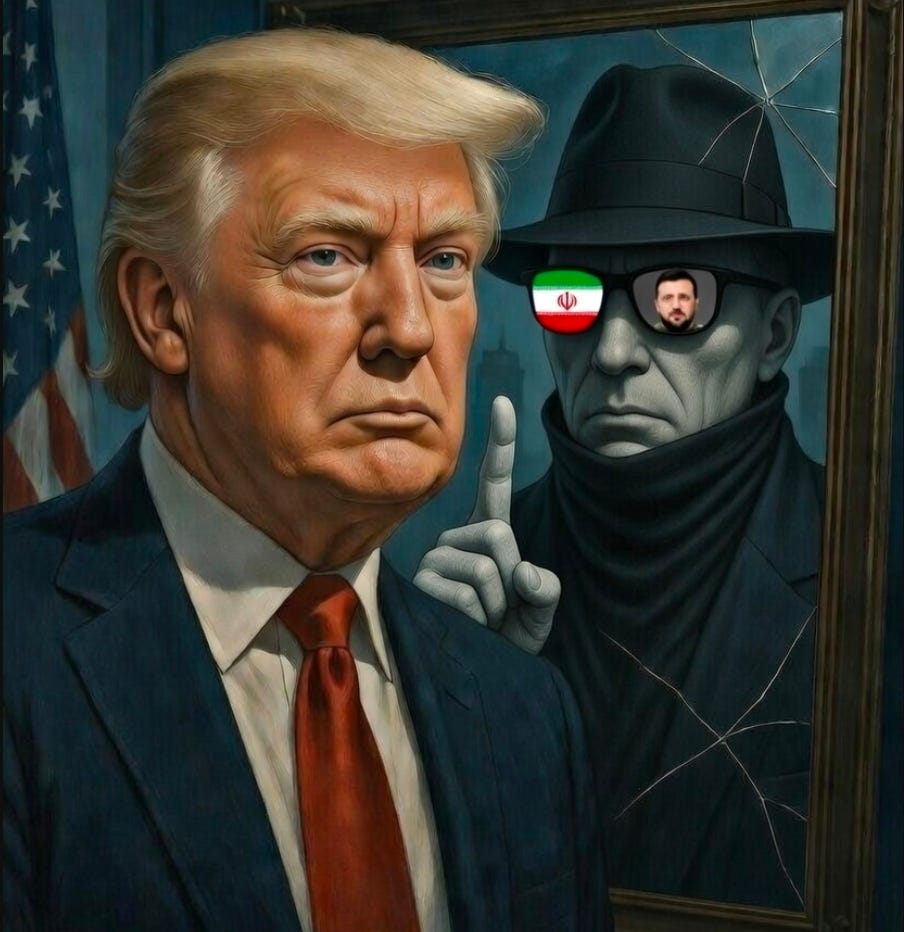
This scenario is everything Donald Trump campaigned against and promised to end if elected. This is what made him different from the establishment and got the people to vote for him. Yet when it comes to actually preventing forever wars, brokering international peace, or doing the things that actually win a Nobel Peace Prize, President Trump turns out to be his Own Worst Enemy.
As always, I thank you for your continued support and readership.
Sincerely,
Jon Kurpis
DISCLAIMER
The Jon Kurpis Substack is a personal platform and reflects only my individual thoughts, opinions, and perspectives. Nothing published here should be interpreted as official communication or correspondence in my capacity as an elected official. The views expressed do not represent the positions of any municipality, governing body, political party, or any other elected official or government entity.